
The listing won’t mention the red flags. We will. Every official register we can query for your state, each one named.
In about a minute: before the inspection, before the auction, before you fall in love.
See your flags.Free
The flag count is free, with no signup. The full report is a one off purchase, from A$19.
Official government registers onlyTested on 11,000+ real addressesFull refund if a report cannot be built
None of these is visible from the street, and every one of them sits in an official register. The report answers each for your exact address and names the register it came from.
A building can look freshly painted and still carry a rectification or stop work order. In NSW we check the in-force building work orders register for the address.
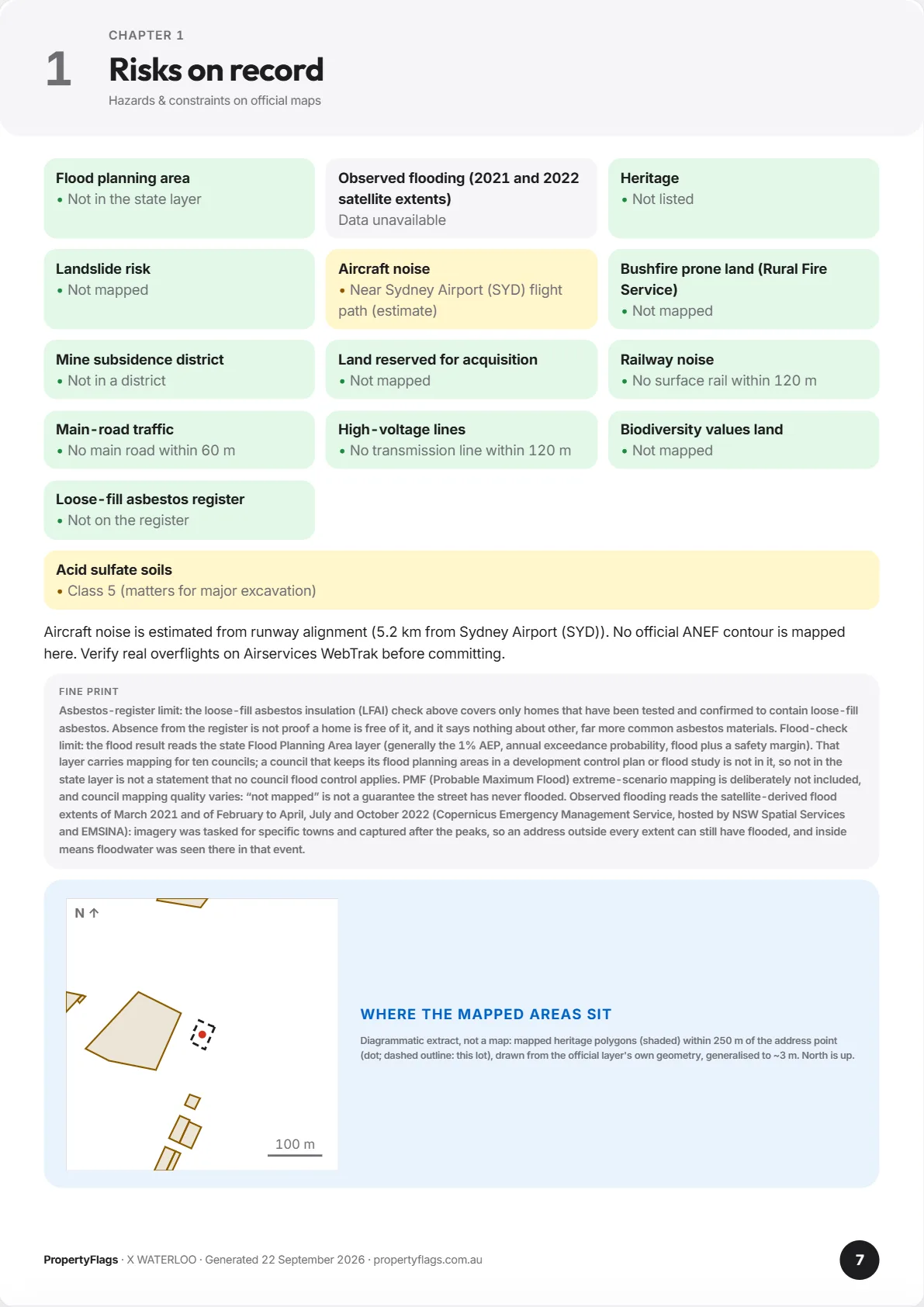
A dry street tells you nothing. We show the mapped flood category with a diagram of the mapped extent around the property, evidence you can put in front of an insurer before you offer.
The apartment block behind the back fence sits in a register long before it appears on site. Where the state publishes development applications, we list what is lodged and approved nearby.
Former service stations and dry cleaners leave entries on the contamination registers. A nearby entry is a yellow flag for the property, with what it means and what to ask.
Open homes are quiet by schedule. We check current aircraft noise corridors, and around Sydney the Western Sydney International corridors before they switch on.
Checks vary by state. Your report names every register it consulted and says plainly when a state does not publish one.
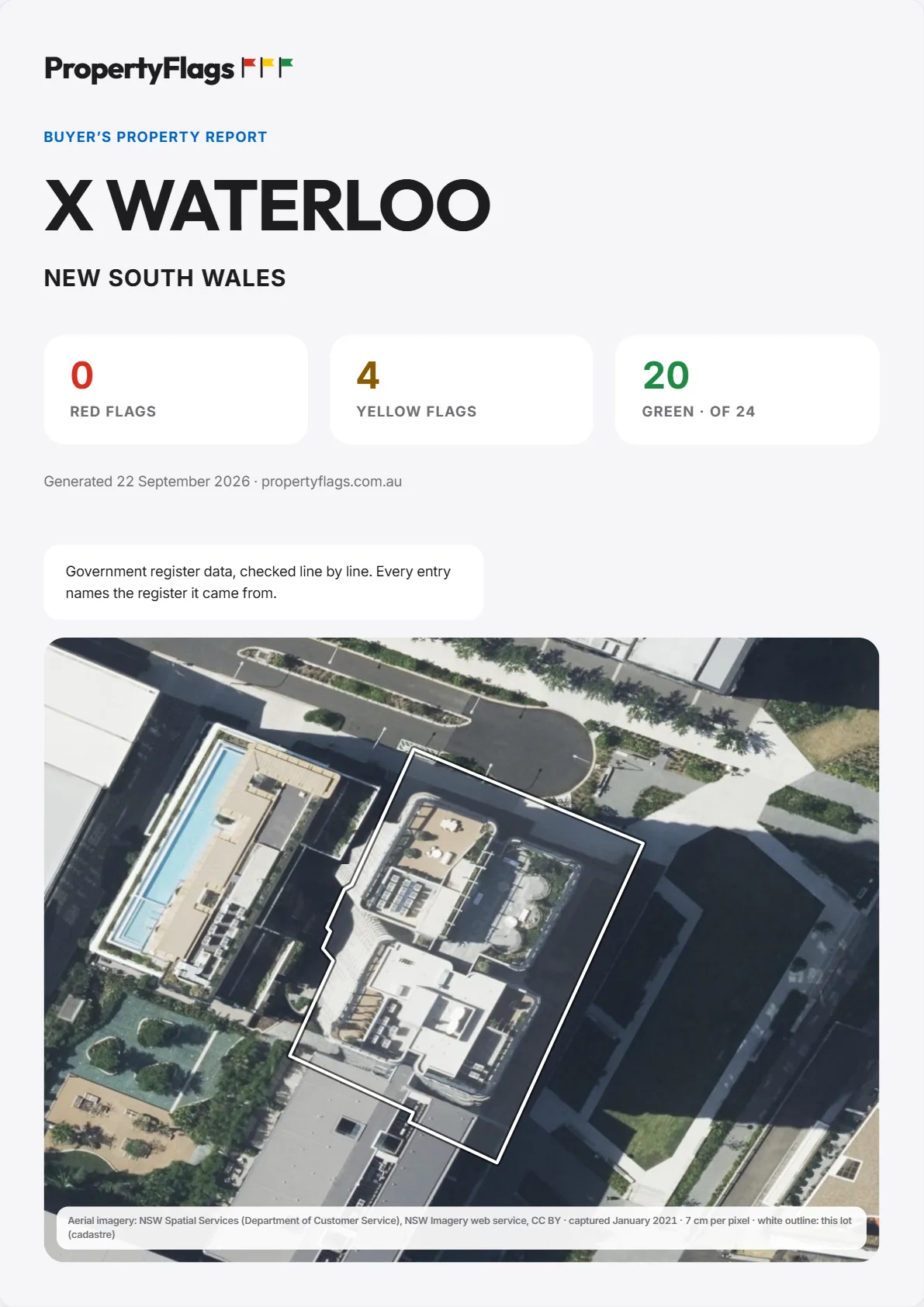
An illustration of how a scan comes together, with example data, not a live query. Checks from the four data chapters land one at a time, each resolving to a flag. The real thing consults every official register we can query for your state; the counts are free and the evidence is the report.
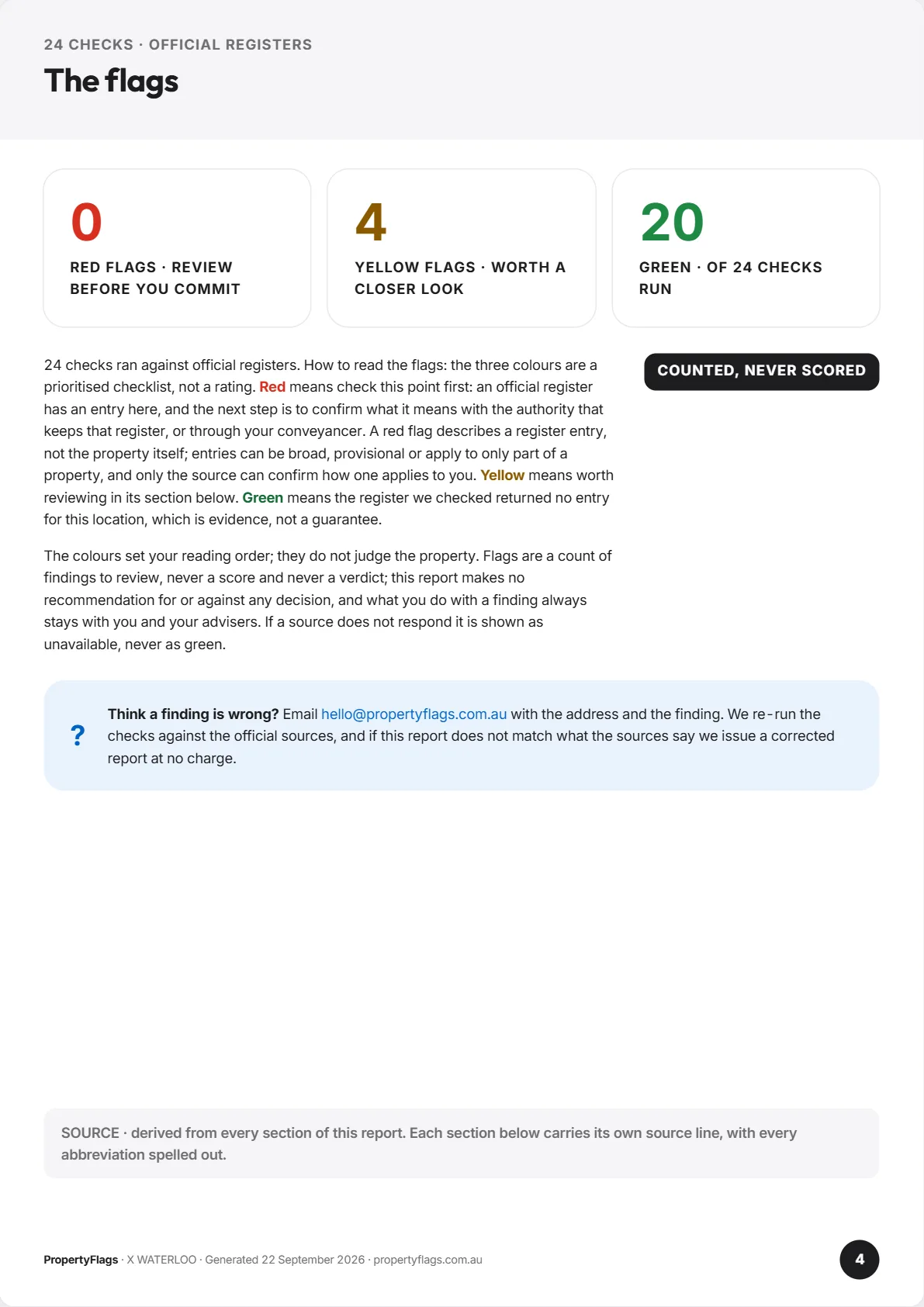
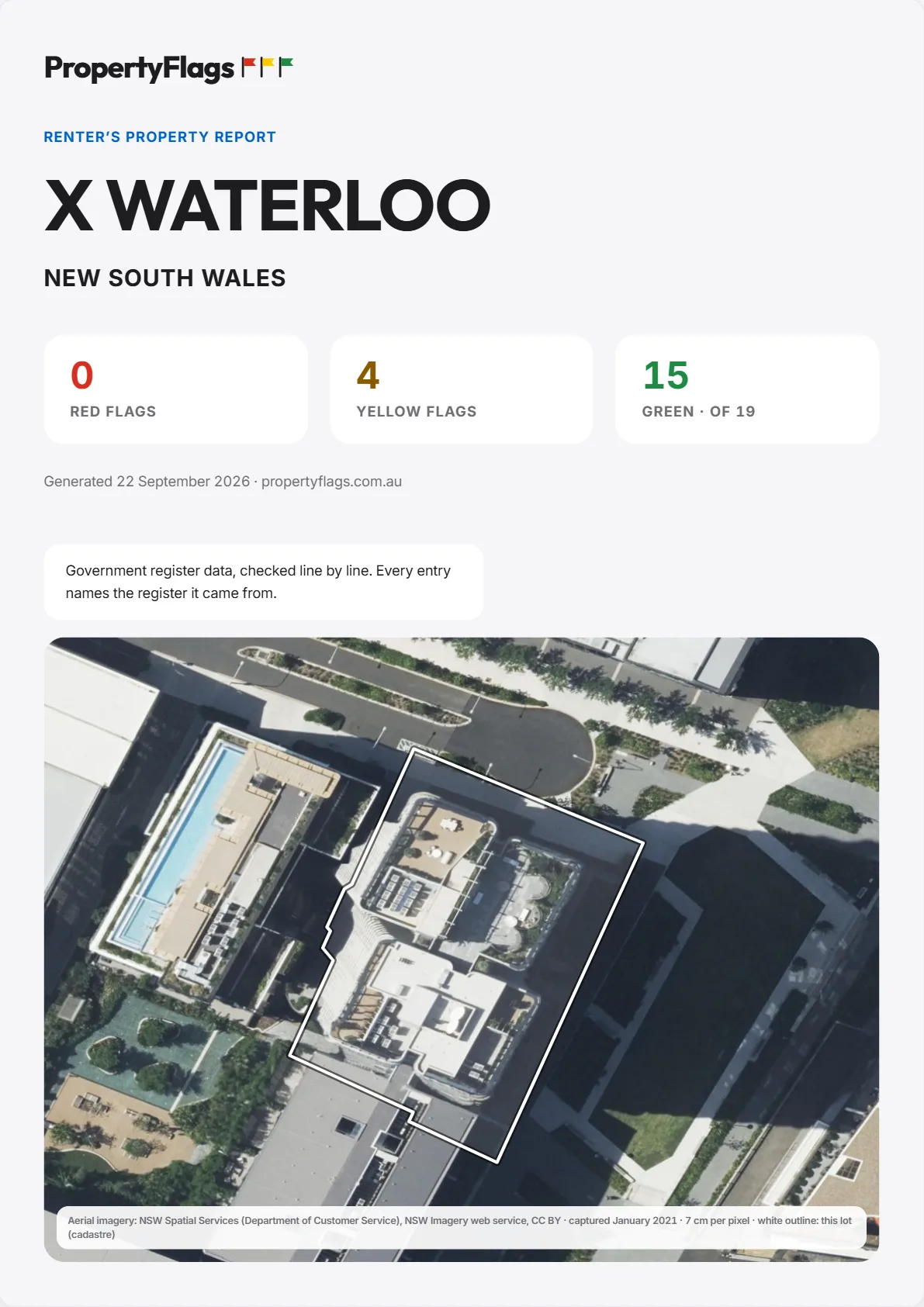
How to read the flags: the three colours are a prioritised checklist, not a rating. Red means check this point first: an official register has an entry here, and the next step is to confirm what it means with the authority that keeps that register, or through your conveyancer. A red flag describes a register entry, not the property itself; entries can be broad, provisional or apply to only part of a property, and only the source can confirm how one applies to you. Yellow means worth reviewing in its section below. Green means the register we checked returned no entry for this location, which is evidence, not a guarantee. The colours set your reading order; they do not judge the property. Flags are a count of findings to review, never a score and never a verdict; this report makes no recommendation for or against any decision, and what you do with a finding always stays with you and your advisers. If a source does not respond it is shown as unavailable, never as green.
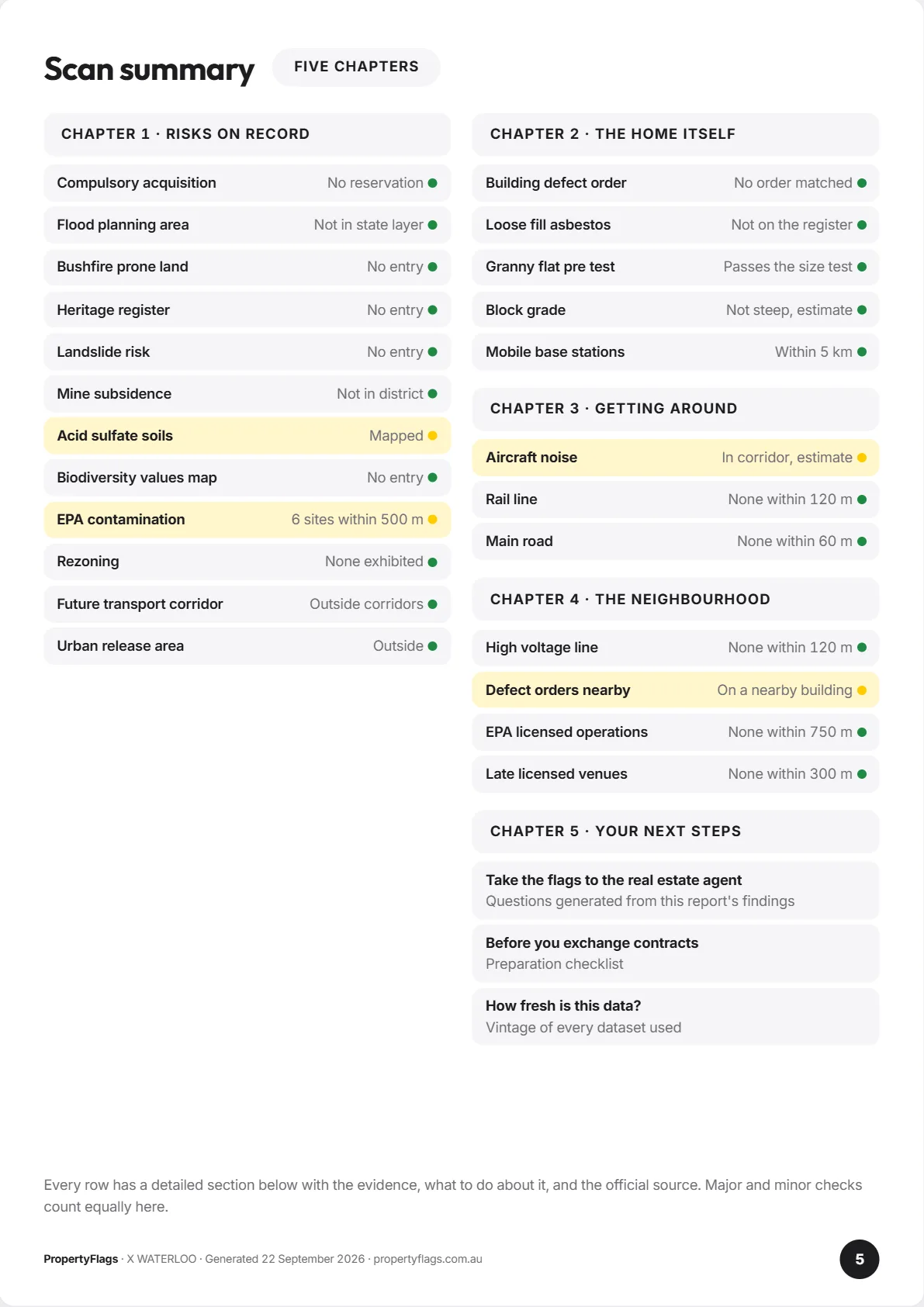
The report opens with the flag summary and a scan ledger, then walks the findings the way you’d actually think about a home.
Flood, bushfire, contamination, heritage, acquisition: the registers that bite.
Defect orders, zoning, winter sun, internet, building approval history.
Stations, buses, main road exposure, aircraft and rail noise, walk climbs.
Catchments, crime vs the NSW rate, childcare, what’s being built.
Questions for the real estate agent, the exchange checklist, how fresh each dataset is.
The honest numbers, as of the May 2026 national address file. If an address is in a covered state, we can search it; the free flag count works on every one of them.
Every dataset in a PropertyFlags report comes from a government register or an official operator, used with attribution. No hearsay, no scraped listings, no opinions. These are the registers the reports draw on, across every state we cover.
WA cadastre and planning layers are used under licences still being finalised with Landgate, DPLH and DWER. WA reports are not on sale yet.
Each report draws on the official registers of its own state and names every dataset it used. Agency names identify the data source and imply no endorsement; the full licence and attribution list is in every report footer.
Flood, bushfire, contamination, defect orders, rezoning, noise, catchments, crime, all pulled straight from official government registers and returned in plain English, with the official source on every line.
The s10.7 certificate arrives weeks after your offer. The flags arrive in about a minute, while the decision is still fully yours.
Renting, not buying? The renter check runs the same registers and tells you what they mean for the place you’d be living in, from A$19: see both reports.

No scores, no grades, no verdicts. Every check lands in exactly one tier, the flags show you where to look, and the decision stays yours.
“0 red flags” still shows in red, the tile keeps its colour whatever the count. And yellow is called yellow.
Data first, plain English second, then what to do about it, and the official source on every single line:
Building Commission NSW issued a building work rectification order for waterproofing defects in the common areas of this strata plan in November 2024. The order is still listed as active.
What to do: ask the real estate agent for the strata’s remediation schedule and the latest AGM minutes, rectification costs can fall on owners through special levies.

Same engine, same registers, same honesty rules, scoped to the decision you’re actually making. Every line names its official source, and when a register does not answer we say so instead of showing you a green tick.

Will you sleep, commute and pay bills happily here? Questions phrased for the property manager.
Every register, every chapter, plus what the lot can become, and the questions for the real estate agent.
Need reports for many addresses, as an agency, a buyer’s agent or a conveyancer? Write to hello@propertyflags.com.au and we’ll sort out a bundle.
The report grows in the direction people ask for. Tell us what you wish it checked, we read every message, and the good ideas get built.